

How To Set Proxy In Ubuntu Terminal
Overview
Proxies are usually plant on concern networks, merely they are increasingly becoming popular for personal apply. The post-obit tutorial will show y'all multiple ways of setting your proxy in Ubuntu 18.04, allowing y'all to browse the Internet with additional privacy.
This tutorial will comprehend the post-obit three areas. Use the one the fits your needs.
Desktop: learn how to set your proxy settings from inside the desktop.
Final: set environment variables for your proxy server when using a terminal or panel.
All users: setting the proxy settings for all users on the system.
Ubuntu Desktop Network Settings
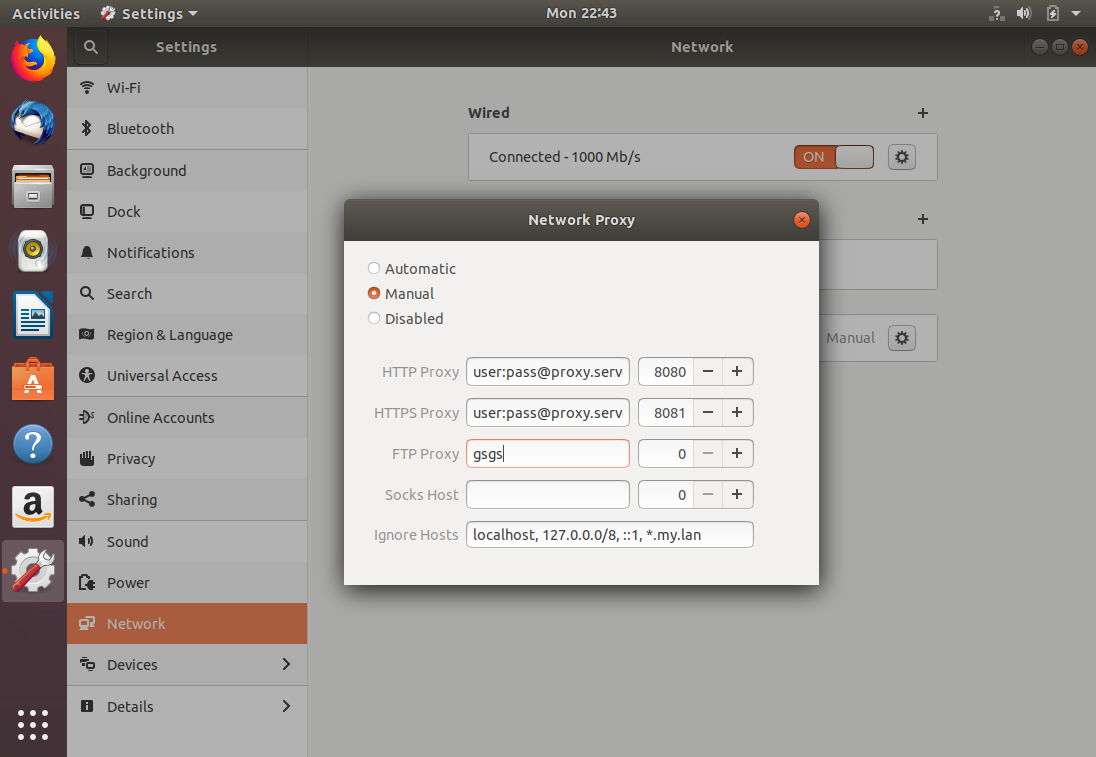
To configure your proxy settings in Ubuntu Desktop you need to access Network Settings. Within there yous tin gear up a number of parameters, including proxy settings for HTTP traffic, HTTPS traffic, and FTP traffic.
Every bit equally important equally setting your Internet proxy settings is setting Ignore Hosts, to prevent local traffic from going through your proxy server.
To set your proxy in Ubuntu Desktop, practice the following:
- Open the Application launcher by clicking the "Prove Applications" icon, located at the lesser of the left-hand quick application access bar.
- Type in 'Settings'
- Click the 'Settings' icon.
- From the left-hand navigation, click the Network tab.
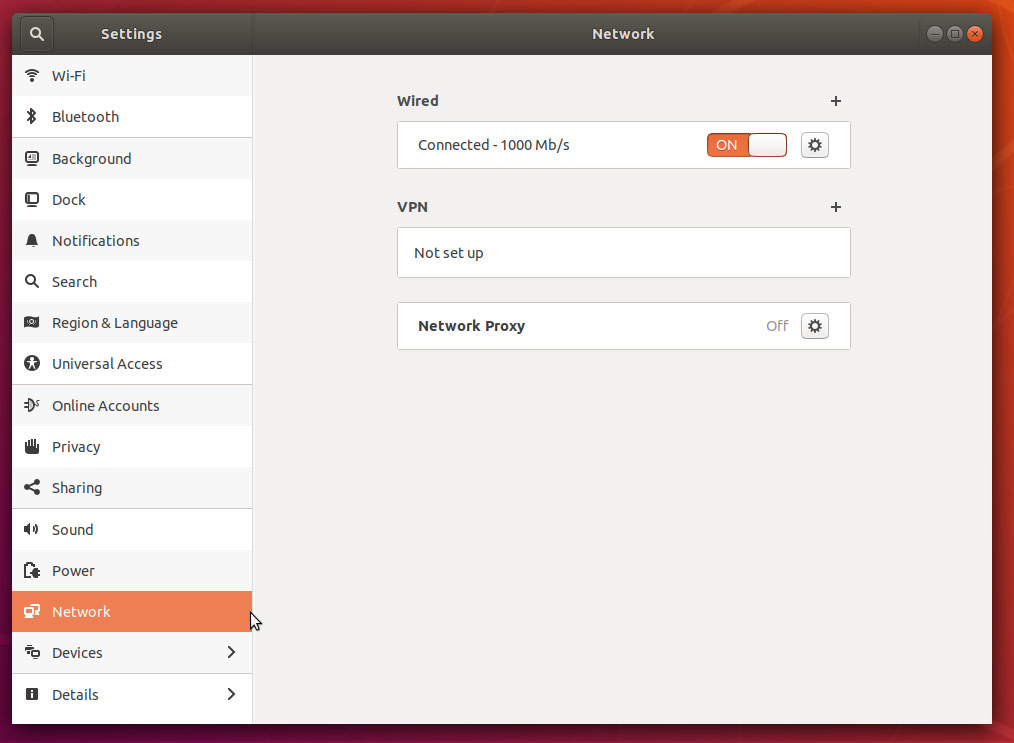
Network Settings Configuration Screen - Click the cog icon near the Network Proxy label.
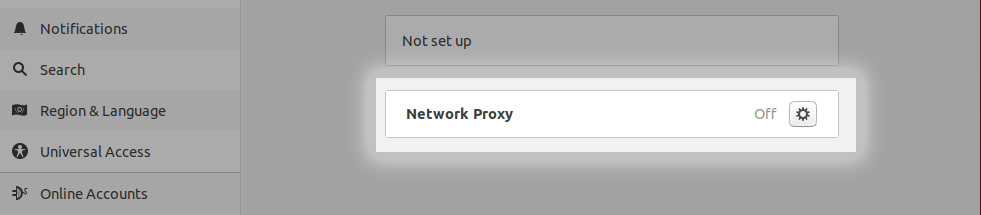
Network settings proxy icon - A dialog box will appear where you tin can set your proxy settings.
- In the advisable text fields, enter your proxy server's hostname or IP address. Ensure yous modify the port number to match your proxy server's, also.
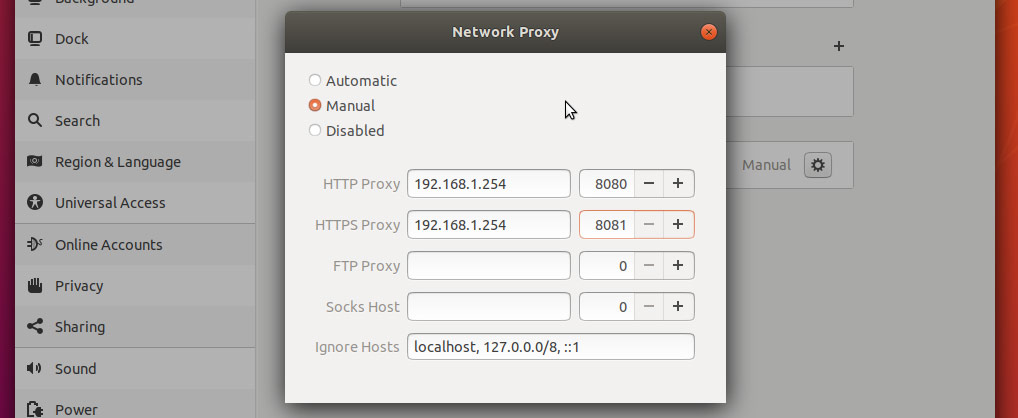
Ubuntu Proxy Settings Dialog Box - Close the dialog box. Your settings will be automatically saved.
Ubuntu Terminal Proxy Settings
Similar every Linux distribution, proxy settings can be set using environs variables. There are a number of variables available to utilize, ranging from HTTP traffic to FTP traffic.
Proxy settings can be either persistent by setting them in your profile, or non-persistent by setting them from the shell session.
| Variable | Description |
|---|---|
| http_proxy | Proxy server for HTTP Traffic. |
| https_proxy | Proxy server for HTTPS traffic |
| ftp_proxy | Proxy server for FTP traffic |
| no_proxy | Patterns for IP addresses or domain names that shouldn't apply the proxy |
The value for every proxy setting, except forno_proxy, uses the aforementioned template. They all require a hostname, but yous may optionally specify a proxy server port and your user credentials if required to do then. For example:
proxy_http=username:[email protected]:port
Single User Temporary Proxy Settings
You lot may not e'er desire to force Internet traffic through a proxy. Sometimes y'all need to override existing settings, and yous can practice this safely past setting the proxy environment variables from the command line.
The post-obit will set a proxy for HTTP and HTTPS, while preventing local traffic from going through the proxy. Our example proxy server endpoint is my.proxy.server:8080 for HTTP traffic and my.proxy.server:8081 for HTTPS.
- Open a Terminal window where you demand proxy access.
- Set and export the HTTP_PROXY variable.
export HTTP_PROXY=user:[email protected]:8080
- Set and consign the HTTPS_PROXY variable.
consign HTTPS_PROXY=user:[email protected]:8081
- Set and consign the NO_PROXY variable to prevent local traffic from being sent to the proxy.
export NO_PROXY=localhost,127.0.0.i,*.my.lan.domain
Single User Persistent Proxy Settings
- Open your bash contour file into a text editor.
half dozen ~/.bash_profile
- Add together the post-obit lines, modifying them to friction match your environment.
export http_proxy=username:[email protected]:8080 export https_proxy=username:[electronic mail protected]:8081 exprot no_proxy=localhost, 127.0.0.ane, *.my.lan
- Save your settings.
- The proxy settings will be applied the adjacent time you start a session, by logging into the server or opening a new Terminal window from a Desktop.
- To force utilise your new proxy settings in the electric current Concluding session, execute the source control against your fustigate contour.
source ~/.bash_profile
All Users
You volition need administrative rights to perform this task. All versions of Ubuntu and Debian take a file called /etc/environs. Inside this file, we tin can prepare global variables and other such things.
Similar to how y'all fix proxy settings for your own local proxy, nosotros'll exist adding the environment variables to this file. The variables will be set when a new user session is created, which is to say when you log in next.
- Using an ambassador account, open up /etc/environment into a text editor.
sudo vi /etc/environment
- Add together the post-obit lines, modifying them to fit your environment. Username and countersign may exist omitted, if non required.
http_proxy="http://<username>:<password>@<hostname>:<port>/" https_proxy="http://<username>:<countersign>@<hostname>:<port>/" ftp_proxy="http://<username>:<password>@<hostname>:<port>/" no_proxy="<pattern>,<design>,...
For example, if you lot do not demand to enter a username or password, and your proxy server is my.proxyserver.net at port 8080, and you do not desire local traffic going through the proxy, you lot would enter the following:
http_proxy="http://my.proxyserver.internet:8080/" https_proxy="http://my.proxyserver.internet:8080/" ftp_proxy="http://my.proxyserver.net:8080/" no_proxy="localhost,127.0.0.i,::1
- Relieve your changes and exit the text editor.

How To Set Proxy In Ubuntu Terminal,
Source: https://www.serverlab.ca/tutorials/linux/administration-linux/how-to-configure-proxy-on-ubuntu-18-04/
Posted by: wilsonwereaujubmis1977.blogspot.com
0 Response to "How To Set Proxy In Ubuntu Terminal"
Post a Comment