

How To Set Up Gel Electrophoresis
If you received a Biotech 101 Kit before May 2022, please employ these protocols.
Gel Electrophoresis
Equipment needed
- Bento Lab
- Micropipette
- Beaker
- Microwave
Reagents and Consumables
- Pipette Tips (4)
- Gel Electrophoresis Tutorial Bag
- Electrophoresis Materials Purse
- Distilled or deionized h2o (1L) Not included. You can find this on eBay or Amazon.
- Empty 1L plastic or glass bottle. Not included.
Abstract
This protocol describes how to use Bento Lab for Gel Electrophoresis.
Protocol
-
Mixing the gel
In this protocol, you will cast a i% agarose gel, load the gel with DNA samples and ladder, and separate them using gel electrophoresis. You will demand to have your DNA samples prepared and set up to load into the gel.
1% refers to the per centum of agarose in the volume of liquid. The gel percentage is calculated as (grams of agarose / milliliters of buffer) x 100%. In this gel, we are mixing 0.5g with 50mL, so the calculation is 0.5g / fifty mL x 100%, which gives us a 1% gel.
The standard percentage of agarose for a gel is commonly about 1-ii%. The percentage of agarose that is appropriate depends on the size of DNA fragments you are expecting to separate. The percentage of agarose determines how well the DNA separates, and the resolution of the terminal gel.
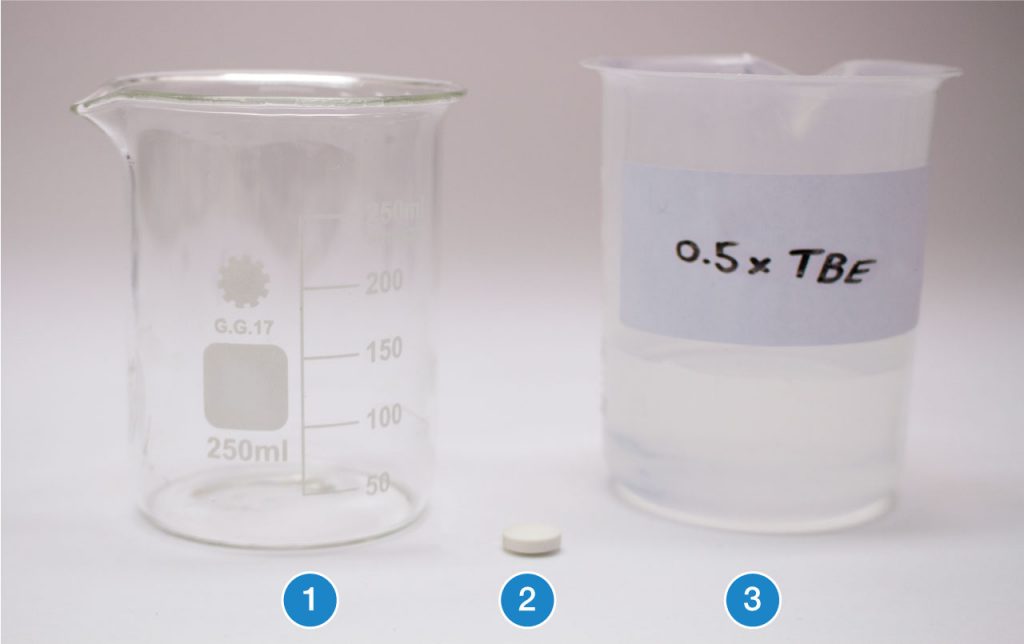
To make a 1% gel, you will dissolve one agarose tablet (2) in the 0.5x TBE Buffer (3), which you diluted in the guide to getting started with electrophoresis. You can use the glass chalice (1) that comes with the Biotechnology 101 Kit.
Driblet the agarose tablet into the beaker, then fill the beaker with 0.5x TBE Buffer to the fifty mL marker. Wait for the agarose to deliquesce. This might take a few minutes. Swirl the partially dissolved tablet in the buffer occasionally.
-
Preparing the gel box for casting
In this step you lot will ready the gel box for casting the gel.
Kickoff, slide open the gel box.
Ensure the black buffer dams are installed correctly, then install one of the combs. In general, all experiments in the Biotechnology Starter Kit use the nine-well-rummage. -
Heating the gel solution in the microwave
Make certain the agarose tablets accept fully dissolved in the buffer. It can take a few minutes.
In one case the tablets have dissolved, heat the solution in a microwave at full ability for short bursts of 20-30 seconds.
Avoid heating the gel solution for also long, or the water in your buffer will start to evaporate. We recommended you heat in short bursts, stop when you see bubbles appearing and swirl the solution. If you overboil the solution, you will terminate up with a higher per centum agarose gel with a loftier ionic concentration.
After each flare-up of microwaving, have out the chalice and swirl the solution. Once bubbling commencement actualization, the agarose should have dissolved. If you lot still come across visibly solid pieces or strings of agarose, keep until they are dissolved.
Be careful when treatment the beaker, as it might go very hot. Touch it indirectly using a cloth or gloves.
-
Adding the Dna Condom Stain
Make sure to wearable gloves from this point on.
Make sure non to betrayal your skin to Deoxyribonucleic acid Stain, or surfaces that have been exposed to Dna Stain.In this pace, you will add the DNA Safety Stain (ane) to the melted agarose (2), to ensure that DNA fragments in the gel will fluoresce.
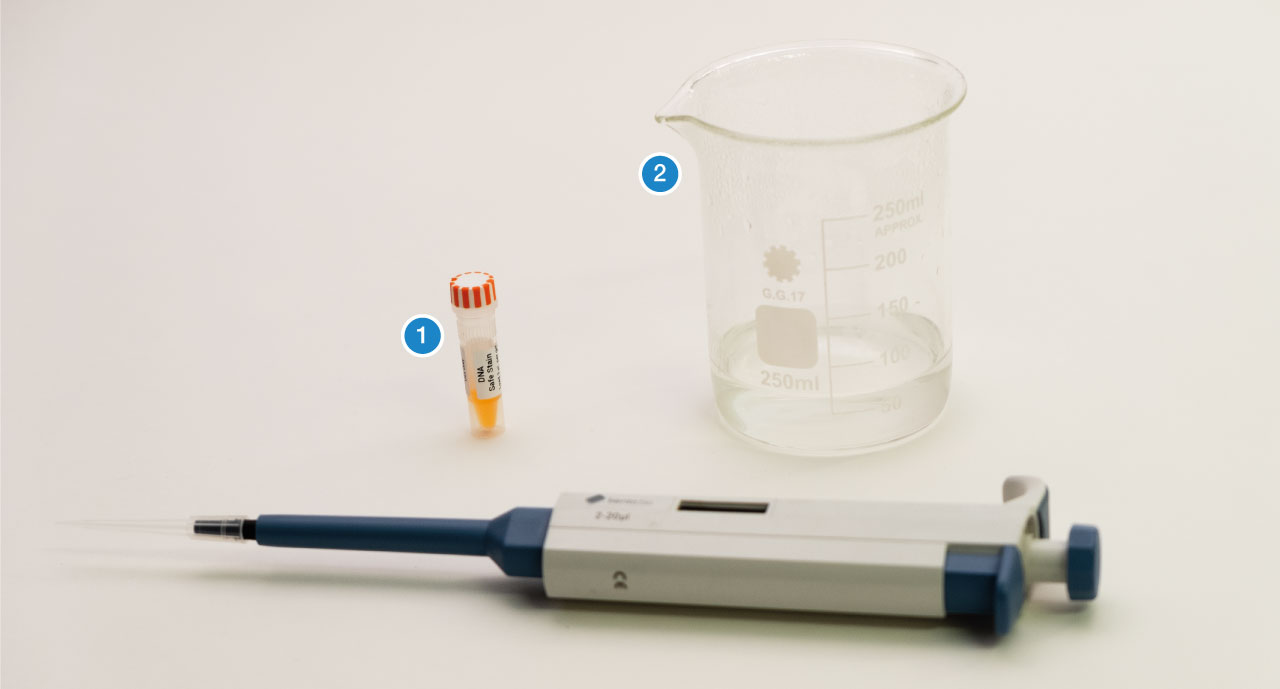
Set the micropipette to 3μl.
Use a fresh tip, so that y'all do not contaminate the stain.
Transfer 3μl out of the Dna Safety Stain tube and add together it to the melted agarose in the beaker. Mix well past swirling the beaker until the stain is evenly dispersed in the mixture.
Add 3μl of DNA Safe Stain to the melted agarose, and mix by swirling the chalice.
Be careful when handling DNA Stain
If you spill some Dna Stain onto your glove or piece of work surface, make sure to clean it thoroughly.
-
Pouring the gel
One time the agarose is fully melted and dissolved, let the solution cool to nigh 55°C. The beaker should feel hot, but not likewise hot to bear on.
Avert pouring agarose to a higher place lxx°C, as this might pb the gel box and rummage warping.
When the agarose has cooled to the correct temperature, pour the solution slowly into the gel box until the half dozen-7mm mark. Once yous have finished pouring, place the comb into the slot.
It will take nearly 30 min for the gel to solidify at room temperature. To speed up the process, you tin also put the gel tray into the refrigerator.
Ensure that the gel box is on a level surface until the gel has solidified. Otherwise the gel thickness will non be consistent.
-
Removing the comb and buffer dams
In one case the gel has solidified, remove the comb and the buffer dams.
Be careful not to impairment the gel as you remove the comb and shutters. When removing the comb, make sure not to pierce the gel.
-
Gel Buffer
In this step, yous volition stop setting up the gel by adding the buffer.
Employ your prepared 0.5x TBE buffer solution over again, and pour it over the gel until the gel is fully covered. The buffer should attain well-nigh 2-3mm above the gel.
-
Loading Dye
Before loading each sample, you demand to add loading dye to each sample – unless your principal mix already contains loading dye, like 5x FIREPol® Master Mix Fix To Load.
The loading dye will add weight to the sample and aid it sink into the well. As the proper noun suggests, it also makes the sample visible, assuasive y'all to visually ostend that your sample is in the well.
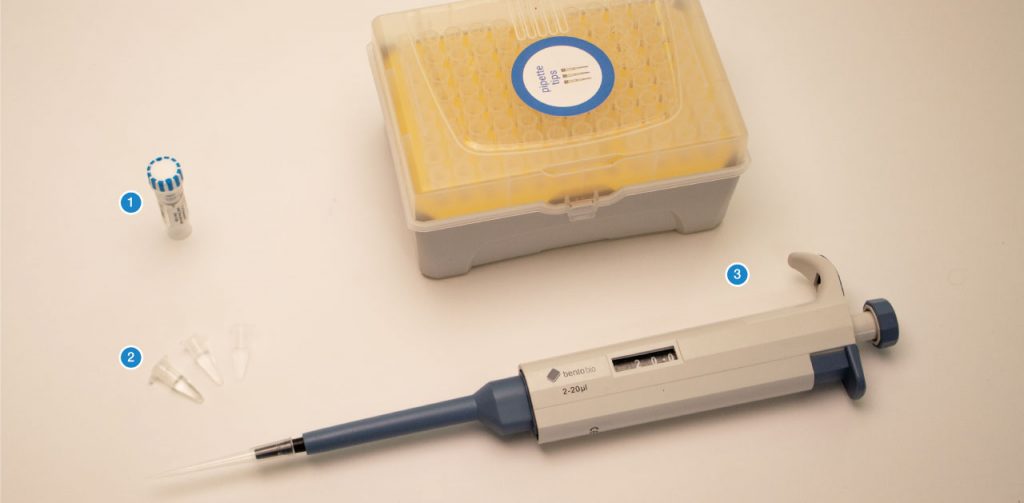
You will need the loading dye (1), the PCR tube containing your sample(south) (2), and the micropipette (three) and tips.
Set your micropipette to 5μl
Transfer 5μl of loading dye from the tube into the PCR tube containing the sample.
If y'all drop the loading dye into the tube without your pipette tip touching the tube or the sample, yous tin utilize the same tip to add loading dye to the adjacent sample. If your pipette tip touches the tube, discard the tip, and brand sure you utilise a fresh tip for the adjacent sample.
If you accept more than ane sample, repeat this.
Employ fresh pipette tips to avoid contagion. If your tip touches a sample, make certain to not put the tip back into the loading dye tube. Otherwise yous may contaminate your loading dye with the Dna from the sample.
-
Loading the gel
The samples are now prepared, and the gel is ready to load.
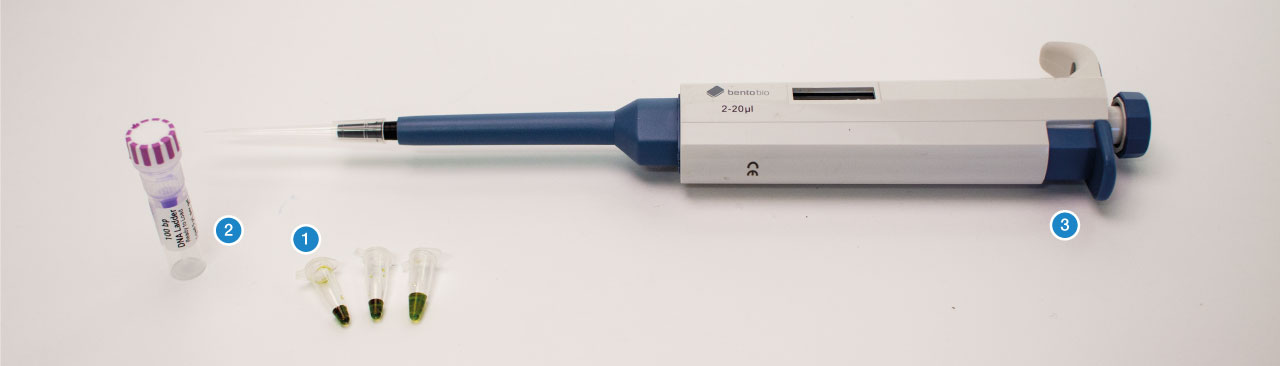
In this step you will load 1 or several samples you lot prepared (1), into the gel yous prepared before. Y'all volition also load the advisable Deoxyribonucleic acid ladder (two) for the experiment. In the Biotechnology 101 Kit, all experiments are designed for a 100bp ladder.
To load the samples into the wells of the gel, you will need the micropipette and several pipette tips (3).If you are working on a brilliant surface, the wells in the gel can exist difficult to spot. Place the gel tray on a darker surface to increase the contrast and run into the wells more clearly. The comb tin can also be used for this.

Brainstorm by loading the DNA Ladder into the first well on the left.
Usually the wells of the gels are numbered and loaded left to right.
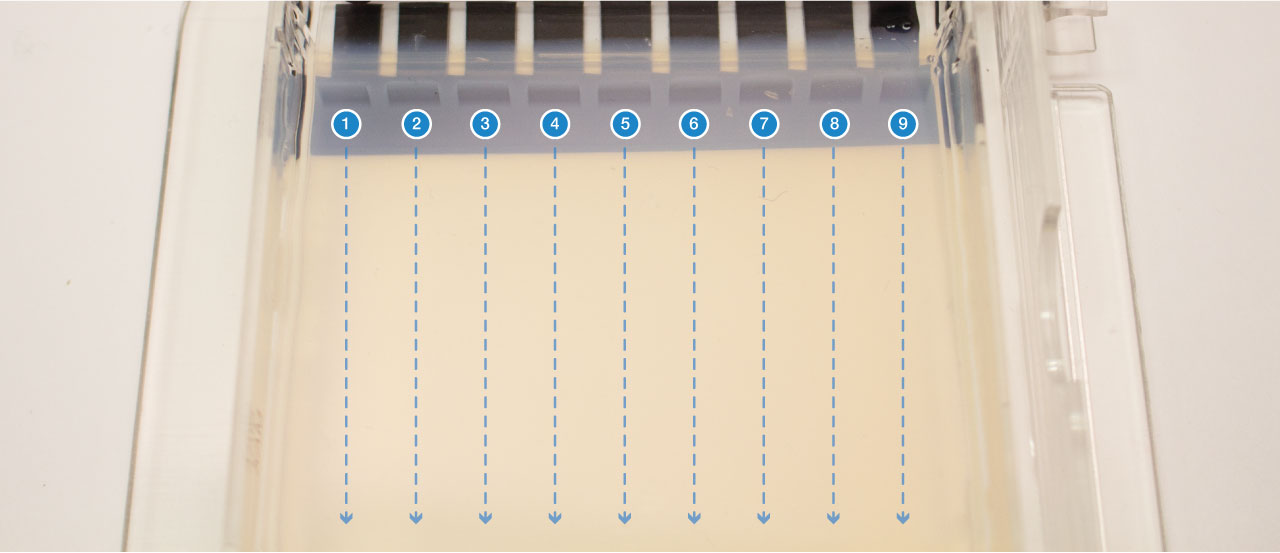
However, if you lot only accept a few samples to load, you might choose to shift the start well to the right, so that you lot lanes are more centered. This is but an artful consideration.
Set your micropipette to 5μl.
Using a fresh pipette tip, describe upward the Deoxyribonucleic acid ladder and load information technology into the well. Later on loading the well, discard the pipette tip.
Now, load the samples yous prepared and load them into the next well.
Using a fresh pipette tip, load 5μl of the sample into an empty well. Discard your pipette tip, and so make a note so that y'all remember which sample is in which well.
Echo this for each sample, taking care to utilize a fresh pipette tip each time.
At the finish of this step, the gel should be loaded with ladder, and all the samples. For each of your samples, y'all should have a note recording which well it has been loaded into.
-
Running the gel
In this footstep, y'all will run the gel for 40 minutes to carve up the Dna fragments.
Gently shut the gel box by sliding the chapeau onto the gel tray. Then connect the leads to the Bento Lab'southward power supply. Be careful not to spill anything.
Run the gel for 40min at 50V.
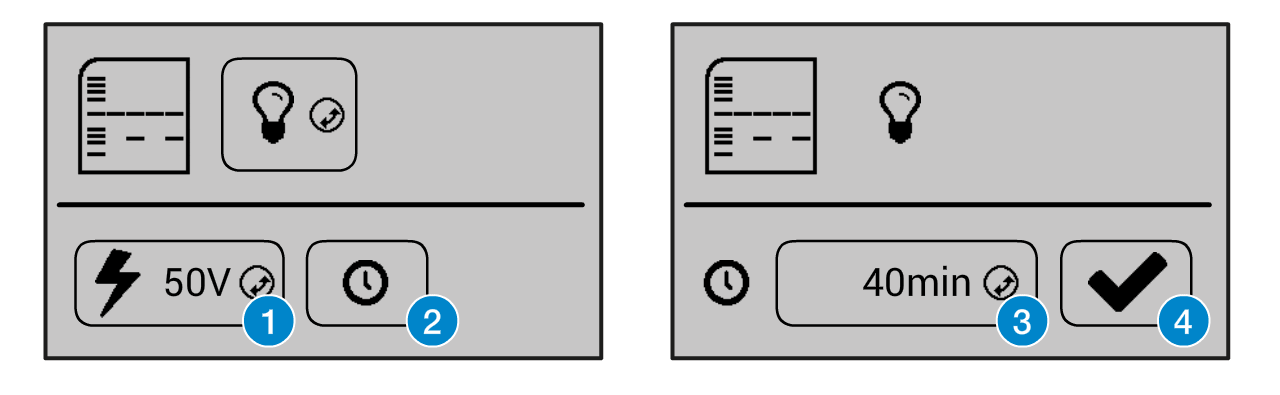
If you need help operating the Bento Lab gel box, check the user manual.
On the Gel Electrophoresis module, ready the voltage to 50V, and then select the timer (2), and set to 40min (3), then, once the gel box is continued, click the confirmation button (4) to start the run. -
Discarding the buffer
Once your run is complete, disconnect the gel box from Bento Lab.
Open up the chapeau and discard the buffer. You lot can dispose of it in the sink.
Your gel is now fix for visualisation via transillumination.


Source: https://bento.bio/protocol/biotechnology-101/gel-electrophoresis/
0 Response to "How To Set Up Gel Electrophoresis"
Post a Comment